




The Late-Season Breakdown: Facing AC Anxiety Without the Upsell
That strange buzzing noise from your outdoor unit is not going away on its own, and as the house warms up, you are likely dreading the inevitable service call. At Airsheen Services LLC, we hear this concern often. If you want to know why we replace your capacitor instead of pitching a whole new AC: the truth about HVAC inspections is that most late-season failures trace back to a single, worn-out component, not a catastrophic system death. The September transition after peak summer heat is notorious for exposing these weak links, leaving homeowners anxious and vulnerable to high-pressure sales tactics.
When the cooling stops, the immediate sinking feeling is completely understandable. Calling a technician often feels like inviting a predatory sales pitch right into your living room. Many homeowners fear that a simple service visit will end with a technician condemning their entire system and demanding a massive replacement project. This fear is exactly why our team believes understanding the difference between a legitimate diagnostic evaluation and a disguised sales quota is so important.
A legitimate professional evaluates your cooling equipment to protect your investment, isolating the specific electrical or mechanical fault that caused the breakdown. By focusing on targeted repairs, you can restore your comfort without draining your savings. For comprehensive air conditioning services, prioritizing an honest evaluation is the first step toward long-term system health.
Why Austin's Summer Heat Pushes Capacitors to the Brink
To understand why late-season breakdowns happen, you have to look at the mechanical reality of your outdoor equipment. Your air conditioner relies on a small, cylindrical component called a capacitor. Think of it as a large, heavy-duty battery that stores electrical energy. When your thermostat calls for cooling, the capacitor delivers a massive jolt of power to start the compressor and the fan motors. Without this initial boost, the motors simply cannot overcome the physical resistance required to start spinning.
In our years of serving Austin area homes, our technicians have seen firsthand how the local climate places an extraordinary burden on these electrical components. The grueling, prolonged extreme summer heat forces your compressor into continuous, rapid cycling. This constant demand, combined with ambient temperatures radiating off the pavement and metal housing, degrades the capacitor's internal materials. Over time, its ability to hold and deliver a full electrical charge diminishes.
When you schedule an AC inspection in Austin, a blown capacitor is one of the most frequent discoveries we make. This failure is a normal wear-and-tear event, much like replacing the brake pads on your car. It does not mean your entire cooling system is dead. The degradation process usually follows a predictable sequence:
1. Thermal stress accumulation: Continuous high-heat operation causes the internal oil or dielectric fluid inside the casing to break down and lose its insulating properties.
2. Charge capacity drop: The component can no longer store the required microfarads (the unit of measurement for electrical capacitance), meaning it cannot deliver enough power to the compressor.
3. Hard starting: The compressor struggles to turn on, pulling excessive amperage and generating even more heat in a vicious cycle.
4. Component failure: The casing may physically bulge or leak fluid, resulting in a system that hums loudly, blows warm air from the vents, or simply refuses to turn on at all.
Recognizing these symptoms early can save your compressor from permanent damage, proving that a targeted repair is often all that is needed.
What a Transparent HVAC Inspection Actually Looks Like
A legitimate diagnostic inspection is a comprehensive, tool-based evaluation of your system's electrical components, refrigerant levels, and airflow, designed to isolate the exact point of failure rather than guessing based on the age of the unit. During the September transition after peak summer heat, this level of precision is exactly what separates a professional repair from an opportunistic sales pitch.
Honest technicians approach a broken system like investigators. They do not just glance at the outdoor unit and declare it too old to fix. Instead, they use specialized diagnostic tools to measure the exact performance of every moving part. This process serves as a shield against predatory sales tactics, emphasizing transparent testing over aggressive replacement pitches. If you need Austin AC repair, you should expect our technicians to prove exactly what has failed.
A thorough diagnostic visit by our team will always include specific checks to rule out minor component failures before ever discussing a full system replacement. You should expect the technician to perform the following steps:
• Visual casing inspection: Checking the capacitor for physical signs of failure, such as a swollen top, bulging sides, or leaking dielectric fluid.
• Electrical continuity testing: Ensuring that power is actually reaching the outdoor unit from the main breaker panel and the thermostat wire.
• Contactor evaluation: Inspecting the magnetic switch that pulls power into the system to ensure the contacts are not pitted, burned, or welded shut.
• Motor amperage draw: Measuring how much electricity the fan motor and compressor are pulling to verify they are operating within the manufacturer's safe range.
Testing vs. Guessing: The Multimeter Difference
The most critical tool in our technicians' bags is the multimeter. This device measures the exact microfarad reading of a capacitor. Every capacitor has a specific rating printed on its label (for example, 45/5 microfarads). If the multimeter shows that the component is only producing 20 microfarads, the part has definitively failed.
Electrical readings prove a part is bad beyond a shadow of a doubt. Homeowners should always ask to see the diagnostic readings on the multimeter screen. A transparent technician will gladly show you the numbers, explain what they mean, and demonstrate exactly why the part needs to be swapped out.
Red Flags: Spotting an Unnecessary Replacement Pitch
When your house is uncomfortably hot, you are in a vulnerable position. Unfortunately, some contractors use this urgency to push aggressive sales quotas. Knowing how to spot the red flags of an unnecessary replacement pitch can save you from a major financial headache. The most common scare tactic involves a technician claiming that a bad capacitor has already ruined your compressor, without ever actually hooking up a multimeter to test it.
Another frequent misdirection is the "refrigerant phase-out" excuse. A dishonest contractor might tell you that because older refrigerants are being phased out, you must replace your entire system immediately—even if your only current problem is a failed electrical switch. While refrigerant changes are a real industry shift, they have absolutely nothing to do with replacing a worn-out fan motor or a blown electrical component. Replacing a single worn part is almost always the correct first step before discussing major system overhauls.
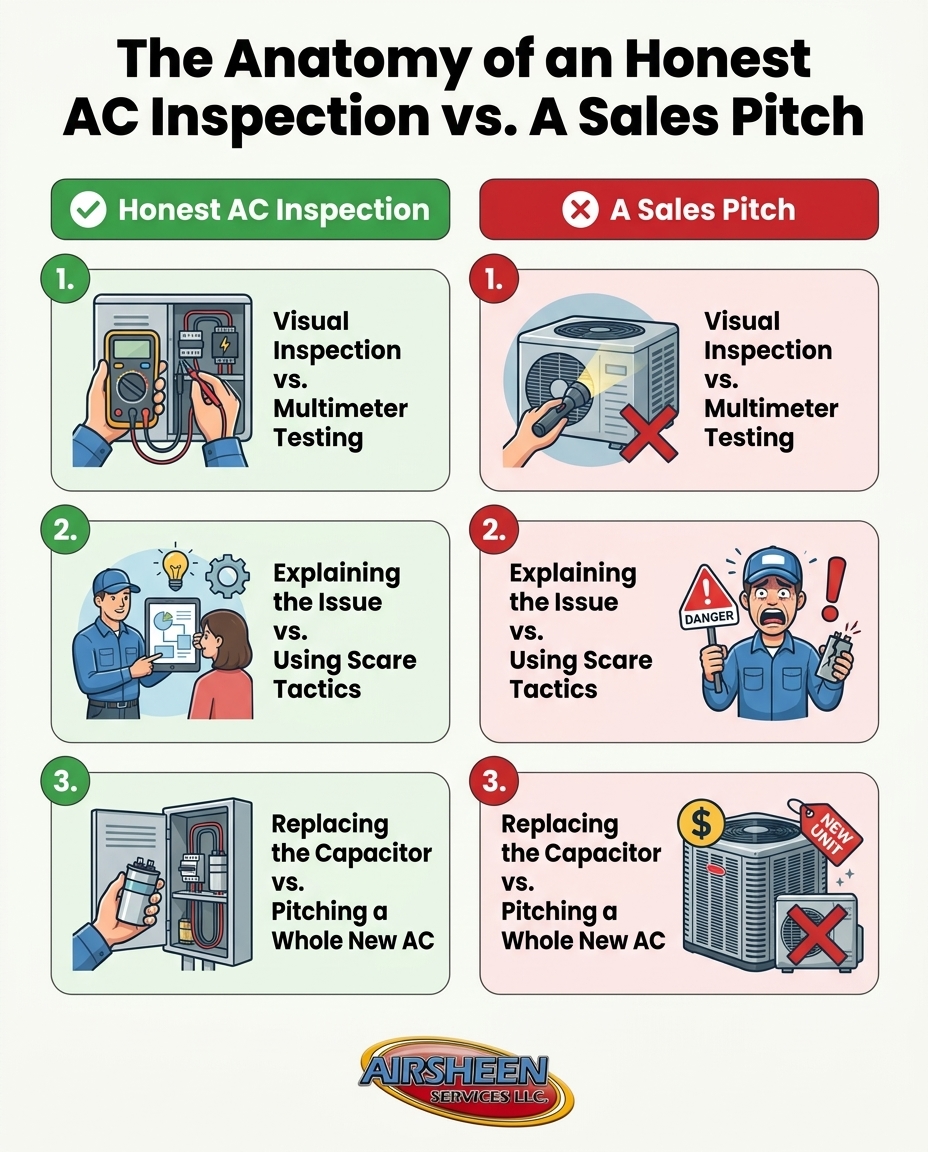
If you are considering an AC replacement, it should be based on a history of major failures, severe inefficiency, or a cracked heat exchanger—never just a single blown electrical part. The table below outlines the stark differences between a true diagnostic visit and a disguised sales call.
• Initial Assessment — Honest Diagnostic Approach: Uses tools to test individual components and isolate the electrical fault. — Predatory Sales Pitch: Glances at the unit, notes its age, and immediately suggests it is too old to fix.
• Proof of Failure — Honest Diagnostic Approach: Shows you the multimeter readings and explains the microfarad deficit. — Predatory Sales Pitch: Refuses to show the failed part or uses confusing technical jargon to avoid explaining the issue.
• Repair Strategy — Honest Diagnostic Approach: Recommends replacing the minor electrical part to restore full functionality. — Predatory Sales Pitch: Claims the broken part has "likely" ruined the whole system and pushes a complete, unneeded system replacement.
• Pressure Level — Honest Diagnostic Approach: Provides options, answers questions, and allows you time to decide. — Predatory Sales Pitch: Uses fear tactics, claiming your family will be without air for weeks if you do not buy today.
Rejecting the industry tendency to push full-system replacements for minor failures is a core standard of transparent service. Always demand proof before agreeing to scrap a system that might just need a minor tune-up.
Diagnostic Proof: Replacing the Part, Not the System
The true value of an honest inspection becomes obvious when you look at real-world applications in Austin area homes. Older systems are frequently condemned simply because they have reached a certain age milestone, regardless of their actual mechanical condition. However, age alone is not a reason to throw away a functioning air conditioner.
A recent service call our Airsheen Services LLC technicians handled highlights how this diagnostic approach works in practice. A local homeowner experienced an unspecified AC issue that completely halted their cooling during a particularly warm stretch. The natural fear was that the aging unit had finally failed for good. Instead of jumping to a replacement conclusion, the responding technician followed a strict diagnostic protocol. They opened the service panel, isolated the electrical fault, and fixed the issue effectively by swapping out the specific failed component.
The outcome was immediate. Cool air was restored, the lifespan of the existing equipment was extended, and the homeowner avoided a massive, unexpected project. The homeowner later noted it was the most transparent service experience they had encountered, which is exactly the standard our team strives for every day. This is the direct result of an ethical technician prioritizing the most logical, practical repair path.
When comparing AC replacement to AC repair, the decision should always be grounded in data. If the compressor is strong, the refrigerant lines are sealed, and the airflow is adequate, replacing a minor electrical part is the only correct recommendation.
Protecting Your System Through the Fall Transition
Fixing a broken air conditioner is a relief, but preventing the breakdown in the first place is the ultimate goal. The September transition after peak summer heat is the most critical time to evaluate component wear and tear. Transitioning out of peak cooling season offers a brief, valuable window to correct thermal stress before the heating season begins and your system shifts into a different operational mode.
Catching a weak capacitor during a routine check prevents the compressor from hard starting. When a compressor hard starts, it pulls massive amounts of electricity, causing the internal windings to overheat. Over time, this secondary damage will destroy the compressor entirely, turning a minor electrical fix into a major mechanical disaster. A structured maintenance approach catches this electrical fatigue early.
Enrolling in an AC and heat protection plan shifts the power back to the homeowner, eliminating emergency breakdown anxiety. Proactive care provides several distinct advantages:
1. Baseline performance tracking: Technicians record the microfarad readings of your electrical components every season, allowing them to spot a decline before the part actually fails.
2. Thermal stress reduction: Cleaning the condenser coils and ensuring proper airflow allows the system to reject heat efficiently, lowering the ambient temperature inside the electrical cabinet.
3. Extended equipment lifespan: By replacing minor electrical parts before they cause extensive secondary damage to your compressor, you maximize the return on your original HVAC investment.
Taking action during the early fall ensures that your home remains comfortable, efficient, and protected against surprise failures as the weather finally begins to cool down.
Frequently Asked Questions About AC Diagnostics and Capacitors
What is included in an AC inspection?
A professional inspection includes a comprehensive review of electrical components, refrigerant levels, and airflow dynamics. Technicians perform specific testing of capacitors, contactors, and fan motors using diagnostic tools like multimeters to verify performance. This detailed process isolates exact failures rather than relying on visual guesswork, ensuring your Austin area home gets an accurate repair plan.
How do I know if my AC capacitor is blown?
The most common sign is that the outdoor unit may hum loudly, but the fan will not spin. Inside the house, the system often blows warm air because the compressor cannot start without the capacitor's energy boost. If you look closely at the outdoor unit, the capacitor itself may appear visibly swollen, bulging at the top, or leaking fluid.
Can a bad capacitor ruin my AC compressor?
Yes, if left unaddressed, a weak capacitor forces the compressor to work much harder to start, causing it to pull excessive amperage and overheat. This condition, known as hard starting, slowly bakes the internal wiring of the compressor. Timely replacement of a degrading capacitor prevents this severe secondary damage.
Should I repair or replace my AC unit?
You should base the decision on the precise age of the unit, the severity of the required repair, and the overall efficiency of the system. Minor electrical parts like capacitors, contactors, and fuses should almost always be repaired, regardless of the system's age. Replacement should only be considered when major components like the compressor or heat exchanger fail, or when the required repair is so extensive that it outweighs the benefits of keeping an older, inefficient unit.
How long does an AC capacitor usually last?
A standard capacitor typically lasts 5 to 10 years, depending heavily on daily usage and local climate conditions. Extreme heat environments, like the long summers in Texas, significantly accelerate wear and tear on these electrical parts. Regular maintenance helps track this degradation so the part can be replaced before it fails completely.
Why do HVAC companies always push for replacement?
Some contractors focus on aggressive sales quotas rather than performing thorough diagnostic repairs. They use a late-season breakdown as leverage to sell major equipment replacements to vulnerable homeowners. Seeking a second opinion is vital if a contractor condemns your system without showing you diagnostic proof, such as multimeter readings or a specific mechanical failure.
Get Honest Answers for Your AC Issues Today
A sudden breakdown during the September transition after peak summer heat does not automatically mean it is time for a brand-new system. As we have seen, the vast majority of these late-season failures come down to a single, overworked component that has simply given all it had to get you through the summer. Replacing a part is a standard, practical procedure that can restore your cooling in a matter of hours.
The value of having an honest technician accurately diagnose the root cause of your issue cannot be overstated. By relying on multimeter readings and transparent testing, you protect your home from unnecessary upsells and keep your current equipment running stronger, for longer. If your system is struggling to keep up, secure a transparent evaluation today and get the honest answers you deserve.
Recent Posts
Customer Testimonials