


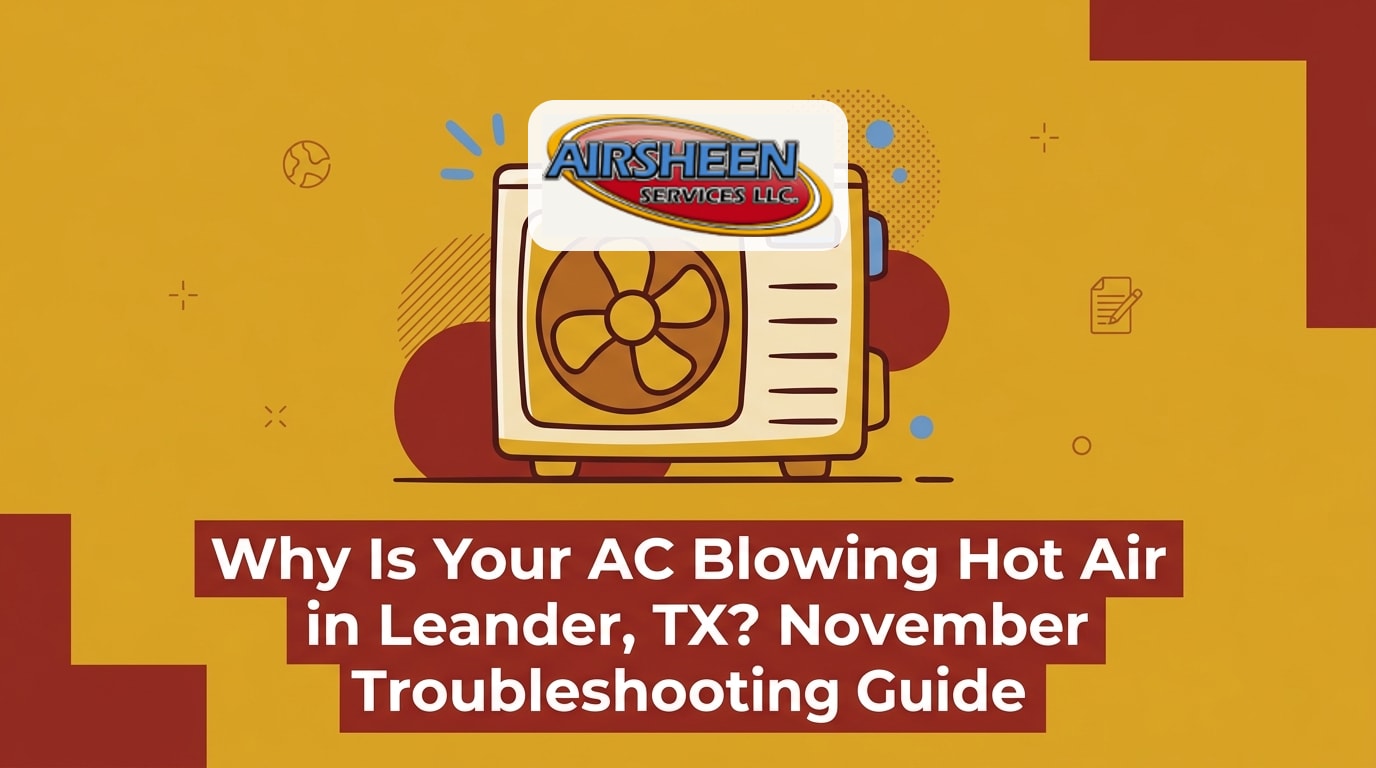
Is Your AC Blowing Warm Air During the Fall Transition?
Are you looking for reliable local service expertise and area tips because your AC is suddenly blowing warm air during the unpredictable November pre-winter transition? You are not alone. At Airsheen Services LLC, our team sees this constantly. Transitioning a residential heating system for Austin's sudden winter temperature drops after months of heavy summer wear often reveals hidden mechanical issues. When your vents start blasting warm air on an unseasonably hot autumn afternoon, it forces a critical decision point: figuring out which pre-winter HVAC readiness checks are urgent right now. If you need professional help navigating this seasonal shift, scheduling an AC repair in Leander with our experienced technicians is the most effective way to restore your system's reliability.
The frustration of an HVAC system blowing hot air when you need cooling is a common pattern we see throughout the Austin TX metro area. The autumn months demand absolute flexibility from your climate control system. One day requires cooling, and the next day requires heating. In our experience, this constant switching places immense stress on components that have already been pushed to their limits.
The good news: Not every airflow issue requires a major overhaul. We often find that some temperature inconsistencies stem from simple homeowner oversights that take minutes to correct. However, other symptoms point to deep mechanical fatigue that requires our professional diagnosis. Understanding the difference between a quick fix and a complex mechanical failure is the key to protecting your equipment before the first deep freeze arrives.
How Extreme Summer Heat Causes Fall AC Failures
In our years of restoring comfort across Austin, we've learned that to understand why your system is struggling in November, you have to look at what it endured in August. With 100-degree summers in Central Texas putting maximum strain on HVAC components, your equipment undergoes severe thermal and mechanical stress. Months of running at maximum capacity degrades critical parts, and our technicians frequently see that accumulated damage manifest as system stress during the mild but fluctuating fall season.
When an air conditioner runs for 12 to 14 hours a day to combat the Texas heat, the internal components experience continuous friction, electrical load, and vibration. This sustained workload compromises the system in several ways that only become obvious to homeowners when the weather begins to shift.
Common delayed-failure components our team diagnoses include:
• Run Capacitors: These electrical components store energy to jump-start the compressor and motors. Summer heat degrades the internal dielectric fluid. By fall, we often find the weakened capacitor has finally failed, preventing the outdoor unit from cooling the air.
• Contactor Relays: The high-voltage switches that turn the compressor on and off can become pitted and burned from thousands of summer cycles, eventually sticking open or closed in late autumn.
• Fan Motors: Continuous operation wears down motor bearings. As the bearings lose lubrication, the motor overheats and shuts down, stopping the flow of conditioned air.
• System Belts: In older systems, drive belts stretch and crack under high heat. When they finally snap during a fall temperature swing, airflow ceases entirely.
These delayed failures connect directly to the symptom of your system blowing warm air. If the indoor fan continues to run but the outdoor compressor has failed due to a burned-out capacitor, the system will simply circulate uncooled, room-temperature air through your vents. Identifying these heat-stressed components through a professional Airsheen Services inspection before the first freeze hits is a vital part of the November pre-winter transition.
First Steps: Checking Thermostat Settings and Air Filters
Before assuming your system has suffered a catastrophic mechanical failure, we recommend ruling out the most common user errors and basic maintenance oversights. Many of the service calls our team fields during the fall transition turn out to be simple issues that homeowners can safely correct themselves.
Start your troubleshooting process at the thermostat. The rapid temperature swings of an Austin autumn mean you are likely interacting with your thermostat more frequently than usual. It is incredibly easy to make a wrong selection that causes the system to blow warm air.
1. Verify the fan setting: Ensure your thermostat fan is set to "AUTO" rather than "ON". When the switch is set to "ON", the indoor blower motor runs continuously 24/7, even when the outdoor cooling cycle has cycled off. This means the system will blow unconditioned, room-temperature air between cooling cycles, which feels warm to the touch.
2. Check the system mode: Confirm that the thermostat hasn't accidentally been bumped into heating mode during a warm afternoon. A quick glance at the digital display can save you hours of frustration.
3. Inspect the programming: If you use a smart thermostat, verify that your seasonal schedules have been updated. A schedule designed for summer might conflict with manual adjustments made in November.
If the thermostat settings are correct, the next critical step we advise is inspecting your indoor air filter. Dirty or clogged air filters severely restrict the volume of air passing over the indoor evaporator coil. Without enough warm household air flowing over the chilled coil, the condensation on the coil physically freezes into a block of ice. Once the coil is encased in ice, air cannot pass through it effectively, and the system will begin blowing weak, warm air into your living spaces.
Replacing a clogged filter is a critical first step in seasonal maintenance. If you pull the filter out and cannot see light through the material, it is time for a replacement. Establishing a routine for regular AC maintenance in Leander with our technicians, starting with diligent filter changes, protects the entire system from unnecessary strain.

Blower Motor Issues and Airflow Restrictions
When the thermostat is set correctly and the filter is clean, but the home still refuses to cool, our technicians typically find the problem lies within the mechanical airflow delivery system. The indoor blower motor is the heart of your HVAC system's air distribution. Its primary function is to pull warm air from the house, force it across the temperature-treating coils, and push the conditioned air back through the ductwork.
A failing blower motor can result in weak airflow that barely trickles out of the registers. Because the air is moving so slowly through the ductwork—especially if the ducts run through a hot attic—it absorbs ambient heat and feels warm by the time it reaches the room. Motor degradation often begins with subtle warning signs. If you are wondering why your AC is making a grinding noise, we consider that a strong indicator that the blower motor bearings are failing.
Recently, an Austin homeowner reached out to our team during an unseasonably warm fall afternoon when their AC unit was running, but the house was not getting any cooler. One of our technicians arrived early the next morning, identified a faulty blower motor, and discussed the repair options. We installed the part later that day, restoring a comfortable home environment. This pattern is something we see often in the Austin TX metro area, where continuous operation pushes motors to their breaking point.
Airflow restrictions can also occur outdoors. The outdoor condenser unit relies on a powerful fan to exhaust the heat removed from your home. If the outdoor coil is choked by fallen autumn leaves, overgrown shrubs, or accumulated dirt, the heat cannot escape into the atmosphere. The system overheats, the compressor's thermal overload switch trips, and the indoor unit is left blowing hot air inside. While clearing leaves away from the outdoor unit is a safe homeowner task, we strongly advise that diagnosing the internal electrical health of a blower motor requires proper high-voltage testing by a licensed professional.
Heat Pump Reversing Valve Malfunctions
For homes utilizing heat pumps rather than traditional furnaces, we find that the November pre-winter transition introduces a highly specific mechanical vulnerability: the reversing valve. Because heat pumps provide both heating and cooling from a single piece of equipment, they rely on this specialized component to dictate the system's operational mode.
What Is a Reversing Valve?
The reversing valve acts as the directional control center for the system's refrigerant. Inside the valve, an electrically activated solenoid shifts a sliding mechanism. When shifted one way, the hot, high-pressure refrigerant is routed indoors to warm the house. When shifted the other way, the heat is routed outdoors to cool the house. This directional flow is essential for systems that provide both heating and cooling.
Signs of a Stuck Valve
From our field experience, mechanical failure, electrical shorts in the solenoid, or a physically stuck sliding mechanism are primary causes of incorrect air temperature output during the fall transition. If the valve fails, you will notice distinct symptoms:
• Stuck in one mode: The system is stuck blowing hot air regardless of what the thermostat requests. Even if you demand cooling, a stuck valve keeps the system locked in heating mode.
• Audible warnings: You may hear unusual clicking, buzzing, or hissing noises from the outdoor unit when the system attempts to switch modes.
• Defrost cycle failures: The system may struggle to manage frost buildup on the outdoor coils during cold snaps.
Resolving a stuck reversing valve is never a DIY project. The component is brazed directly into the sealed refrigerant lines. Replacing it requires our technicians to safely recover the existing refrigerant, unbraze the old valve with a high-temperature torch, braze in a new valve while protecting it from heat damage, pull a deep vacuum on the system, and recharge the refrigerant. This process involves strict environmental regulations and requires licensed technical expertise.
Refrigerant Leaks After Heavy Summer Use
One of the most persistent myths our team hears in home maintenance is that air conditioners slowly "use up" or "burn" refrigerant over time. We can tell you firsthand this is entirely false. HVAC systems are closed-loop networks. The refrigerant cycles continuously between a liquid and a gaseous state, absorbing and releasing heat. If your system has low refrigerant levels, it absolutely indicates that a physical leak has developed in the copper lines or the coils.
Without a precise, factory-specified volume of refrigerant, the system's physics break down. The evaporator coil cannot absorb enough heat from the indoor air. As a result, the air blowing out of your vents remains warm. Furthermore, low pressure alters the temperature of the remaining refrigerant, often causing the indoor coil to freeze solid—further blocking airflow and compounding the problem.
Finding the source of a leak requires specialized diagnostic tools. Our technicians use electronic leak detectors, ultrasonic sensors, or ultraviolet dye to pinpoint microscopic pinholes in the metal.
• Hissing or bubbling sounds — Impact on System Performance: Indicates an active, pressurized leak in the copper lines.
• Ice buildup on the indoor coil — Impact on System Performance: Restricts airflow completely; system blows warm air.
• Unusually high energy bills — Impact on System Performance: Compressor runs continuously trying to meet the thermostat demand.
• Long cooling cycles — Impact on System Performance: System struggles to drop the indoor temperature even a few degrees.
We always warn homeowners against simply "topping off" refrigerant. Adding more chemical without locating and repairing the underlying leak is a temporary band-aid that guarantees the system will fail again. Furthermore, handling refrigerant is strictly regulated by federal law and requires professional EPA certification to ensure environmental safety and system integrity across the Austin TX metro area.
When to Call for Professional AC Diagnostics
Knowing where to draw the line between basic homeowner maintenance and professional intervention protects both your safety and your wallet. If you have verified that the thermostat is set correctly, confirmed the system is in the right mode, and replaced a dirty air filter, you have exhausted the safe DIY troubleshooting steps. If the vents are still blowing warm air, professional diagnostics from our team are required immediately.
Ignoring a system that blows hot air is dangerous for the equipment. A struggling system typically forces the outdoor compressor to run continuously. The compressor is the most expensive component in the entire HVAC system. Forcing it to operate with a failed fan motor, a frozen coil, or low refrigerant can lead to catastrophic, irreversible compressor failure.
Addressing these transition issues promptly before winter weather arrives is critical. In one instance, a local homeowner experienced an air conditioning failure late on a Saturday night. Our on-call technician responded without hesitation to the after-hours emergency call, quickly inspected the system, and took care of the AC problem with fair charges despite the late hour. Rely on Airsheen Services LLC's prompt, local expertise in Leander to accurately diagnose and resolve AC airflow and cooling issues without resorting to unnecessary upselling.
A licensed technician brings the right tools—multimeters, manifold gauges, and anemometers—to test the electrical draw of motors, measure the superheat and subcooling of the refrigerant, and verify the integrity of the reversing valve. By trusting our local professionals, you ensure the diagnosis is accurate and the repair is permanent, securing your home's comfort for the November pre-winter transition.
Frequently Asked Questions About ACs Blowing Hot Air
Why is my AC running but blowing warm air during the fall transition?
In our experience, this is often caused by a stuck heat pump reversing valve or low refrigerant levels that prevent heat absorption. During the fall transition, the frequent switching between heating and cooling modes can cause a worn reversing valve to stick in place. It can also be a simple thermostat setting error, such as the fan switch being left in the "ON" position instead of "AUTO". Checking your thermostat settings is the best first step.
How do you fix an AC that blows hot air?
We recommend starting by checking the thermostat to ensure it is set to cooling and the fan is on "AUTO", then replace the indoor air filter if it is dirty. If these basic homeowner steps do not resolve the problem, the fix requires professional intervention. A licensed technician must diagnose mechanical or electrical faults, such as a blown capacitor, a failing blower motor, or a refrigerant leak, and perform the necessary repairs safely.
Can a dirty filter cause my AC to blow hot air?
Yes, severe airflow restriction from a clogged filter can cause the indoor evaporator coil to freeze over entirely. When the coil is encased in ice, the system can no longer absorb heat from the air passing through the ductwork. This prevents proper cooling and results in weak, warm air circulating through your home's vents. Changing the filter regularly prevents this chain reaction.
Why is my house AC blowing hot air all of a sudden?
Sudden changes usually point to an immediate electrical or mechanical failure, such as a tripped circuit breaker, a blown run capacitor, or a broken blower motor. Unlike a slow refrigerant leak which degrades performance over weeks, electrical failures happen instantly. This type of sudden failure requires an immediate electrical inspection by a professional to restore function safely.
What HVAC maintenance is critical before a Texas winter?
Testing the reversing valve, checking all high-voltage electrical connections, and ensuring adequate airflow are the most critical steps our team performs before winter. Because Texas weather fluctuates wildly, your system must be able to switch seamlessly between heating and cooling. It is crucial to perform these professional inspections in November before the first hard freeze hits the region.
How does a heat pump reversing valve fail?
We typically see a reversing valve fail due to a burned-out electrical solenoid coil or a physically jammed internal sliding mechanism. When the solenoid fails, it cannot magnetically pull the internal slide to redirect the pressurized refrigerant. This leaves the system permanently stuck in either heating or cooling mode, requiring a licensed technician to recover the refrigerant and braze in a replacement valve.
Schedule Your Pre-Winter HVAC Readiness Check Today
Navigating the unpredictable temperature swings of the Austin TX metro area requires an HVAC system that is flexible, resilient, and fully operational. A clear, professionally grounded explanation of your system's health from our seasoned team is essential for your peace of mind. Addressing transitional HVAC issues right now prevents emergency breakdowns and panic during the first hard freeze of the season.
Don't wait until your heating system fails on the coldest night of the year. Take proactive steps to ensure your equipment is prepared for whatever the Texas winter brings. We encourage you to schedule a comprehensive inspection with Airsheen Services LLC to verify your heating reliability and safeguard your home's comfort. For trusted, professional Air Conditioning Services, contact our local experts today to secure your pre-winter readiness check.
Recent Posts
Customer Testimonials