




The 35-Degree Daily Swing: Why October Challenges Your Climate Control
During a typical Texas fall, nearly 100% of residential climate control units are forced to operate as both air conditioners and heaters within the same 24-hour window. Navigating Austin's Shoulder Season: Safely Switching Your HVAC Between Heating and Cooling Daily requires more than just pushing buttons on a wall. Central Texas experiences a unique micro-climate during October, characterized by rapid diurnal temperature variations. You might face an 85-degree afternoon that demands full cooling power, followed rapidly by a 50-degree night that leaves your home feeling uncomfortably brisk by morning.
Expecting your HVAC system to instantly swap from cooling to heating creates immense operational stress on the mechanical components. Unlike regions with gradual, predictable seasonal shifts, Austin's extreme temperature swings mean your equipment rarely gets an off-season break. The thermal mass of your home retains the afternoon heat well into the evening, but by 3:00 AM, the dropping outdoor temperatures penetrate the walls, prompting a sudden need for warmth.
Why professional oversight matters: Establishing safe thermostat protocols is the best way to prevent sudden system lockouts, blown fuses, and emergency service calls. While modern thermostats offer convenience, relying entirely on automated settings without understanding the mechanical realities of your equipment often leads to premature wear. Partnering with professional AC service in Austin ensures your system is mechanically prepared to handle these drastic daily shifts before the shoulder season fully sets in.
The Hidden Mechanical Danger of Rapid Mode Switching
Flipping your thermostat back and forth without a buffer does more than waste energy—it actively threatens the mechanical integrity of your outdoor compressor. When an air conditioner runs, it pressurizes refrigerant gas to extract heat from your home. If you immediately switch the system off and command it to heat, the compressor motor is suddenly forced to start against that massive wall of unequal pressure.
This scenario creates a specific mechanical hazard known as a locked-rotor condition. The compressor motor tries to spin but physically cannot overcome the pressure resistance. As it stalls, it draws a massive surge of electricity. This sudden spike in amperage is exactly what leads to blown electrical fuses, tripped breakers, and fried capacitors. We frequently see the aftermath of this rapid switching in the field. One local homeowner experienced an AC unit not blowing cold air alongside potential electrical issues after a sudden mode swap. A technician spent extra time ensuring the unit blew cold air again and verified that all electrical systems were still operating safely within their ratings.
Breaking Down the Mechanical Failures
Understanding the cascade of events during a rapid switch helps illustrate why patience is required at the thermostat. Here is exactly what happens when a system is forced to change modes too quickly:
• Immediate switch from Cool to Heat — The Mechanical Cause: Compressor attempts to start against high, unequal refrigerant pressure. — The Resulting Solution: Motor stalls, drawing excessive electrical current to compensate.
• Sudden electrical surge — The Mechanical Cause: The stalled motor pulls Locked Rotor Amps (LRA), exceeding safe limits. — The Resulting Solution: Safety mechanisms trigger, tripping the breaker or blowing a fuse.
• System lockout — The Mechanical Cause: The control board detects the electrical fault and shuts down all operation. — The Resulting Solution: Requires professional AC repair to reset safeties and replace damaged fuses.
The 5-Minute Rule: Equalizing Refrigerant Pressures
The secret to surviving an 85-degree afternoon to 50-degree night without a system breakdown lies in the physics of refrigerant pressure equalization. Your air conditioner is divided into a high-pressure side and a low-pressure side. When the cooling cycle ends, the refrigerant needs time to bleed through the metering device until the pressure on both sides of the system is equal. This equalization process is not instantaneous.
The industry-standard guideline is simple but non-negotiable: always wait at least 5 full minutes after your system completes a cycle or is turned off before engaging the opposite mode. This brief pause allows the highly pressurized liquid refrigerant to settle. When the compressor finally receives the signal to start the heating or cooling cycle, it does so against a balanced, manageable load rather than fighting a literal wall of pressure.
Digital Delays vs. Manual Overrides
Many modern digital and smart thermostats are programmed with built-in time delays to protect the compressor from short-cycling. If you adjust the temperature and see a flashing "Cool On" or "Wait" message on the screen, the thermostat is actively enforcing this 5-minute rule. However, homeowners often grow impatient during Austin's October shoulder season. Attempting to bypass this delay by repeatedly pressing buttons, pulling the thermostat off the wall, or manually overriding the schedule defeats the safety feature.
• Respect the flashing screen: If your thermostat indicates a delay, allow it to complete the countdown.
• Avoid rapid button presses: Rapidly toggling between heat, cool, and off can confuse the control board and bypass built-in safety timers.
• Understand the stakes: Waiting 5 minutes is a minor inconvenience compared to a weekend without climate control due to a stalled compressor.
Mastering Your Thermostat's Deadband Setting
During the unpredictable weather of fall, many homeowners rely on their thermostat's "Auto" changeover feature. This mode allows the system to automatically switch between heating and cooling based on the indoor temperature. However, using this feature safely requires configuring a proper deadband. A deadband is the intentional temperature gap between your heating setpoint and your cooling setpoint.
Without a sufficient deadband, your system will rapidly bounce back and forth between modes on a mild afternoon. For example, if you set the heat to 70°F and the cooling to 71°F, the system will constantly overshoot its target. The heater will run, push the house to 71°F, and immediately trigger the air conditioner. The AC will cool the house to 70°F, triggering the heater again. This continuous loop causes immense wear and tear, highlighting the differences between indoor and outdoor heat pumps and how they handle rapid cycling.
Setting the Ideal Temperature Gap
To prevent this destructive short-cycling, you must establish a minimum 3 to 5-degree deadband. This gap provides a neutral zone where the system simply rests, allowing the house to naturally absorb or lose heat without mechanical intervention.
Recommended Fall Settings:
• Heating Setpoint: 68°F (The system only heats if the house drops below this number).
• Cooling Setpoint: 73°F (The system only cools if the house rises above this number).
• The Neutral Zone: Between 69°F and 72°F, the system remains completely off, saving energy and reducing mechanical stress.
While the "Auto" mode is convenient, its limitations become obvious if the deadband is set too tightly. If you notice your system turning on and off multiple times within an hour during a mild October day, widen the deadband immediately to protect your equipment.
How Aging Equipment Handles Daily Temperature Swings
As HVAC systems age, their tolerance for sudden operational shifts decreases significantly. A brand-new unit might occasionally forgive a rapid mode switch, but a system that has endured a decade of Texas summers will not be so resilient. Aging equipment is particularly vulnerable to the stress of shoulder season because minor part degradation exacerbates the impact of an 85-degree afternoon to 50-degree night temperature swing.
The primary components at risk are the run capacitors and the blower motor. Capacitors act like large batteries that deliver the initial jolt of electricity needed to start the compressor and fan motors. Over time, these components lose their ability to hold a full charge. When an aging capacitor is asked to start a compressor against unequal refrigerant pressures, it often fails completely. Similarly, older blower motors with worn bearings struggle with the high-torque demands of constant mode switching.
The Value of Pre-Season Inspections
Older compressors also take significantly longer than 5 minutes for internal pressures to equalize due to worn internal valves. What takes a new system 3 minutes might take an older system 10 minutes. This is why proactive care is essential. One local homeowner called late in the afternoon because their aging unit locked up during a sudden mode switch. A technician arrived the same day, handled the issue politely and professionally, and replaced the stressed components to get the system running efficiently again.
Scheduling routine AC maintenance before the deep temperature swings begin allows a technician to verify the electrical tolerances of your aging parts. Replacing a weakened capacitor or a struggling contactor is a minor, cost-effective solution that prevents a catastrophic compressor failure when the weather turns unpredictable.
Your 3-Step Safe Switching Protocol for Fall
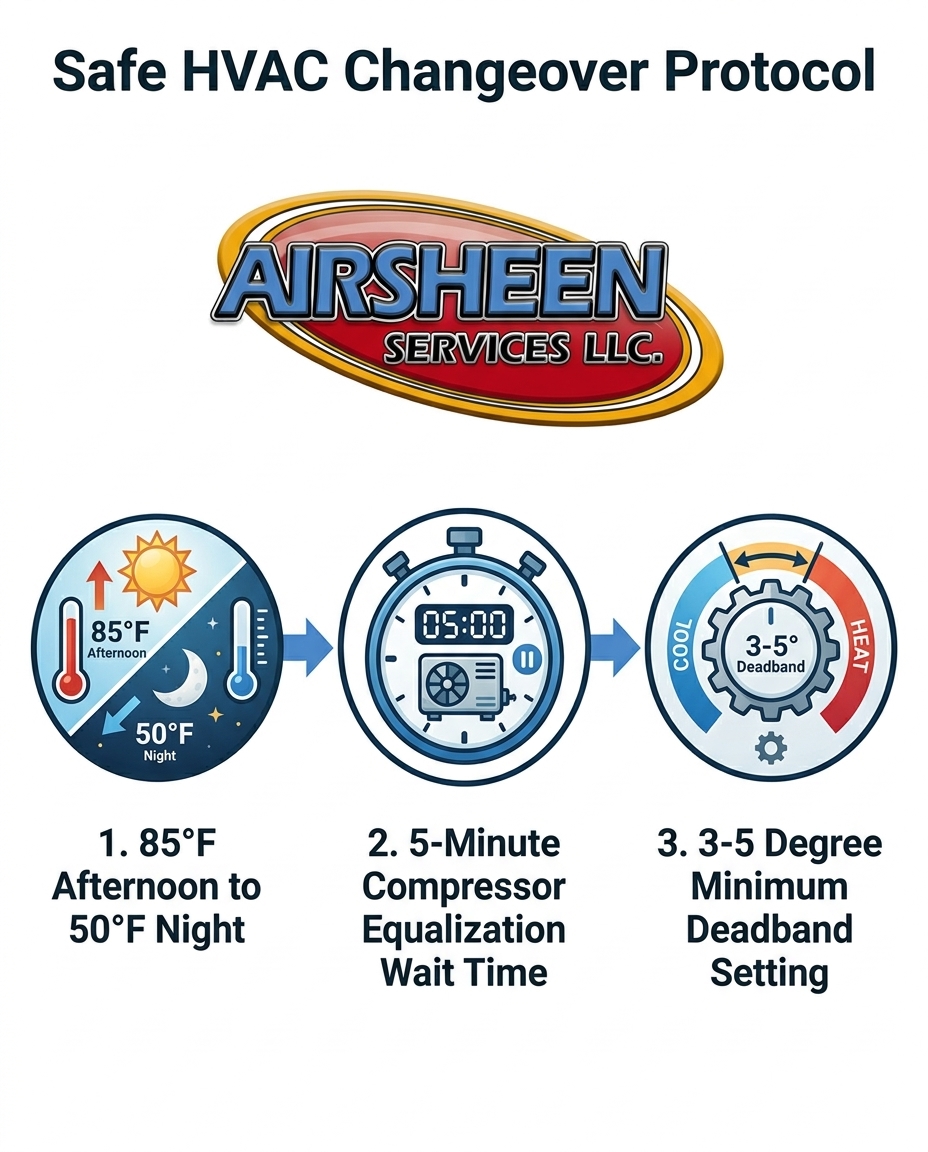
To protect your equipment during Austin's October shoulder season, you need a disciplined approach to climate control. Follow this actionable, 3-step safe switching protocol whenever you need to transition from cooling to heating, or vice versa, within the same day.
1. Step 1: Turn the system to 'Off' and wait a full 5 minutes. Never switch directly from "Cool" to "Heat." Move the selector switch to the "Off" position. Set a timer on your phone for 5 complete minutes. This ensures the high and low-pressure sides of the refrigerant cycle have fully equalized, protecting the compressor from a locked-rotor stall.
2. Step 2: Set a strict 5-degree deadband if utilizing 'Auto' mode. If your thermostat has an automatic changeover feature, verify that the heating setpoint and cooling setpoint are at least 5 degrees apart (e.g., Heat at 68°F, Cool at 73°F). This prevents the system from fighting itself and short-cycling during mild afternoon weather.
3. Step 3: Program distinct daytime and nighttime schedules. Instead of manually adjusting the temperature as you feel hot or cold, program your smart thermostat to align with natural temperature drops. Schedule the cooling to taper off in the late afternoon, allowing the house to drift naturally into the neutral zone before the nighttime heating schedule engages.
Frequently Asked Questions
Is it bad to switch from AC to heat in the same day?
Switching from AC to heat in the same day is perfectly fine, provided you follow safe operational protocols. The danger lies in switching modes instantly without allowing the system to rest. As long as you give the refrigerant pressures time to equalize, your system is designed to handle multiple modes in a 24-hour period.
You should wait a minimum of 5 full minutes after the air conditioner turns off before engaging the heater. This mandatory waiting period allows the highly pressurized liquid refrigerant to settle and balance across the high and low sides of the system. Failing to wait can cause the compressor to stall against unequal pressure. p>Can switching from cool to heat blow a fuse in my HVAC system?
Yes, rapidly switching from cool to heat is a leading cause of blown fuses and tripped breakers during the fall. When the compressor tries to start against high refrigerant pressure, it can lock up and draw excessive electrical current. This sudden amperage spike trips the safety mechanisms to prevent electrical fires or further motor damage. p>What is the ideal thermostat setting for a Texas fall?
The ideal setting involves establishing a 3 to 5-degree deadband to account for drastic daily temperature swings. A common and comfortable configuration is setting the heat to kick on at 68°F and the AC to engage at 73°F. This creates a wide neutral zone where the system remains off during mild afternoon hours. p>Why does my AC compressor lock out after I switch modes?
A compressor locks out when the system's internal safety sensors detect an electrical fault or a high-pressure anomaly. If you switch modes too quickly, the compressor motor stalls, pulling excessive current that triggers the control board to shut everything down. This lockout is a protective measure to save the motor from burning itself out. p>Should I use the 'Auto' setting on my thermostat during shoulder season?
The 'Auto' setting can be highly effective during shoulder season, but only if configured correctly. You must ensure there is a wide enough temperature gap between your heating and cooling setpoints. If the gap is too narrow, the Auto setting will cause the system to constantly bounce between heating and cooling, causing severe wear and tear.
Ready for Reliable Comfort This Fall?
Navigating Austin's Shoulder Season: Safely Switching Your HVAC Between Heating and Cooling Daily doesn't have to end in frustration or blown fuses. By following clear, actionable thermostat protocols, you can maintain perfect indoor comfort without stressing your equipment. If your system is struggling with the transition, schedule your professional AC service in Austin today to ensure your components are ready for the changing weather.
Recent Posts
Customer Testimonials